Online searches begin with search engines, the primary tools that help users find the most relevant information on the internet quickly and in a structured way. Understanding how search engines work from crawling and indexing to ranking helps you develop efficient SEO strategies so your content is easier to discover and prioritized in search results.
What Is a Search Engine
A search engine is a system that crawls, collects, indexes, and displays information from web pages to answer user queries. This process allows search engines to present a list of results (SERPs) based on the relevance and quality of content in relation to the searched keywords.
Why Is It Important to Understand How Search Engines Work?
1. Helping Users and Website Owners Understand How Search Engines Operate
By understanding how search engines function, website owners and content creators can optimize pages to make them easier to crawl, index, and display to the right audience. Users also gain a better understanding of the benefits of search engines in finding relevant and credible answers more quickly.
2. Understanding the Purpose of Search Engines in Managing Information
The main purpose of search engines is to find, understand, and organize web information so it can accurately answer user search intent. This is achieved through a combination of crawling, indexing, and algorithm-based ranking technologies.
3. Supporting the Creation of More Relevant and Competitive Content
Insights into how search engines work help you create content that aligns with user queries and needs, increasing the chances of appearing on the first page of search results.
Schedule a free 30-minute branding consultation session with our experts.
What Is Google Search?
Google Search is a search engine that gathers information from billions of pages and organizes it so users can find the most relevant results based on their queries and search context. Google relies on crawling, indexing, and ranking processes to deliver useful results.
How Search Engines Work
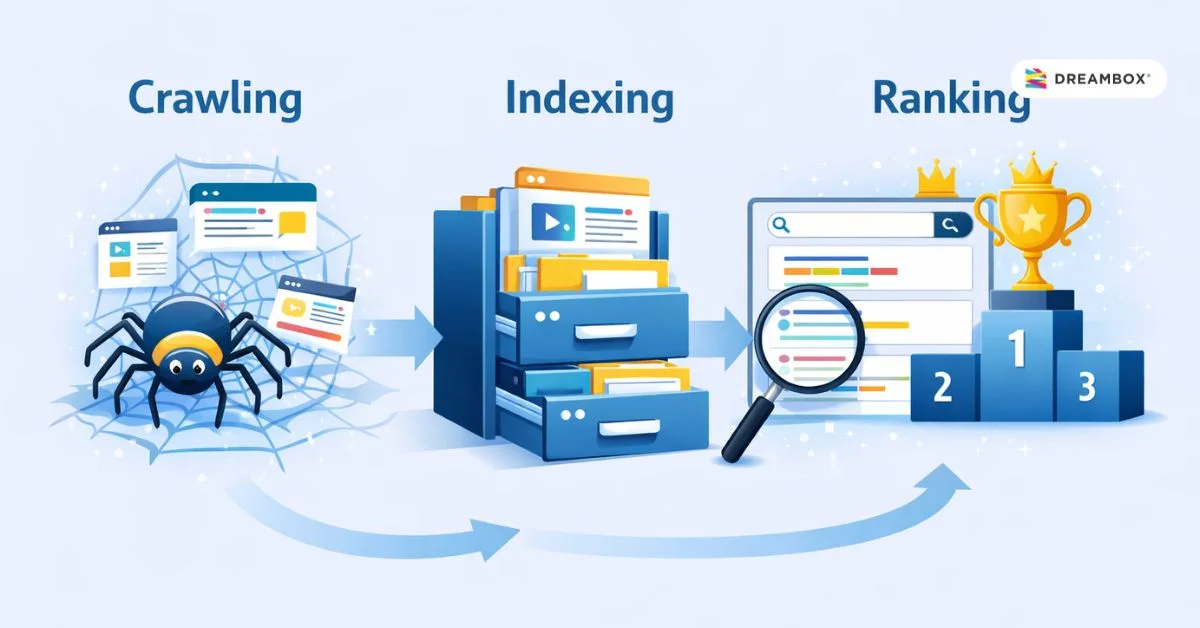
Crawling
Search engines use crawlers or bots to visit web pages and follow links between pages to discover new content or updates. This process does not always reach every page; site structure, robots.txt, and server accessibility can affect how quickly pages are discovered. Well-structured, crawler-friendly sites are generally easier to find and crawl.
How Crawling Works: bots visit URLs, read internal and external links, comply with robots.txt rules and sitemaps, then send page data for further processing.
Indexing
Information from crawled pages is analyzed and stored in an index so it can be retrieved when a search occurs. Search engines evaluate elements such as text, titles, and structure to understand page topics. Pages that are difficult to interpret, blocked, or in violation of guidelines may not be indexed.
How Indexing Works: the system processes content, extracts key signals such as text, metadata, and links, and stores them in an index database.
Ranking
From indexed pages, search engines determine result order based on relevance and quality in relation to user queries. Algorithms assess multiple signals to present the most useful results at the time of the search. Results are then displayed on the SERP in appropriate formats, such as organic links or other features.
How Ranking Works: the system matches queries with the index, evaluates relevance and quality signals, and orders pages for display to users.
Factors That Influence Search Engine Rankings
1. Content Quality and Relevance
Content that addresses user intent, is informative, and easy to understand has a higher chance of achieving better rankings.
2. Website Structure and Performance
Clear structure, organized navigation, and fast loading speeds make it easier for crawlers to operate and enhance user experience, which can support rankings.
3. Backlinks and Website Authority
Links from other sites act as trust signals that can strengthen authority and visibility in search results.
Differences Between Search Engines and Browsers
Search engines are used to search for and index information on the web, then display results based on relevance.
Browsers are applications used to access and display web pages requested by users.
The Relationship Between Search Engines and SEO
The Role of SEO in Assisting Search Engines
SEO helps search engines understand site structure and content through practices such as technical optimization, content optimization, and link building, making crawling and indexing easier.
Optimization for Both Machines and Users
Good SEO practices balance algorithm requirements with user experience to achieve sustainable results.
Types of Search Engines Around the World Besides Google
Google is the most widely used search engine, but it is not the only one available in different countries. Below are several other search engines:
1. Bing
Bing is developed by Microsoft and accounts for around 20% of internet usage. Although its user share is smaller than Google’s and innovation is relatively limited, Bing is still used by certain segments of internet users worldwide.
2. Yandex
Proficient in Russian? You may benefit from Yandex, a search engine whose results are primarily in Russian. While many Indonesians may not be familiar with it, its scale is quite large according to Alexa data.
3. DuckDuckGo
DuckDuckGo differs from other search engines by eliminating ads from its search results. It also emphasizes privacy, allowing users to feel more comfortable and better aligned with the results provided.
4. Yahoo
Yahoo, once popular as an email service, also has a search engine. When visiting its site, users are presented with current entertainment news, the latest updates, and a search field at the top of the page.
5. Ask
Ask originally started as a question-and-answer site but later evolved to provide search engine functionality similar to those above. Today, users can access a wide range of global information through Ask.
6. Ecosia
Interested in contributing to environmental sustainability? You can use Ecosia as a search engine, as its revenue allocation is used for tree planting initiatives. For reference, Ecosia partners with Bing to display search results.
That concludes an overview of the benefits, how search engines work, and several search engines around the world besides Google.
Ready to Optimize SEO? Collaborate with Dreambox
Understanding how search engines work crawling, indexing, and ranking is the foundation for increasing organic visibility and driving high-quality traffic. Explore Dreambox’s professional SEO services for measurable, results-oriented strategies. Need quick guidance? Contact the Dreambox team and discover the latest insights on the Dreambox blog. It’s time to start optimizing your website with Dreambox today.